Amazon’s Real Time Targeting!

Image


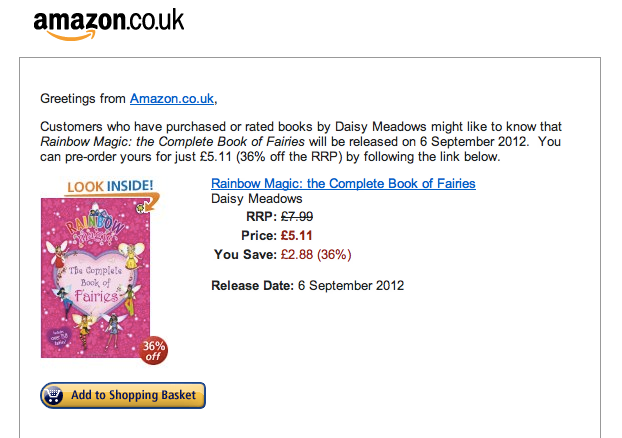
I received the above email from Amazon the other day. Generally I find that Amazon’s recommendations are pretty good. However in this case they don’t seem to be taking the target audience into account. When my youngest daughter was much much younger she was interested in these fairy books and I bought quite a few of them. 

However I haven’t purchased one of these books since 2007! Amazon don’t seem to have realised that perhaps my daughter has grown up a little since then. I can imagine the response I would get if I suggested purchasing one of these books now. 

Service as a Differentiator I

In the main business to consumer industries there has been a large degree of product commoditisation over the last decade. Take a look at the mobile phone industry, often the same handsets are available from all of the operating companies and there is a remarkable similarity between all of the tariffs which are on offer in a supposedly competitive market. The virtual network operators piggy-back on existing networks (for example Virgin Mobile on the Everything Everywhere network http://www.virginmobile.com/vm/ukCoverage.do?contentId=coverage.in.uk.howdoi.sm235) and even large brands share network infrastructure (http://www.guardian.co.uk/technology/2012/jun/07/vodafone-o2-4g-shared-network) either because of strange business holdings or just because of the huge capital cost associated with building new networks.

In the financial services industry you can buy essentially the same product from any one of a number of retail financial services organisations. In the insurance market consumers are often surprised by the end provider of the branded products that they have purchased. You have similarities with the telecommunications market with “virtual” financial institutions (for example Sainsburys Bank) who do not manufacture any products. Even for those financial product manufacturing businesses (interesting to look at those who have crossed from virtual provider to manufacturer such as Tesco Bank) there is a large degree of similarity in the products that are offered – often due to the financial mechanics of making profitable products (http://www.money.co.uk/current-accounts.htm).

So where does this leave these so called competitive business-to-consumer organisations if all of their products are now so commoditised that consumers can no longer make decisions to purchase based on product features? The common reaction and the focus for many large organisations has been to focus on the service delivered to their customers as the place that they can differentiate themselves within the market. This is a difficult “feature” of your product to quantify but this hasn’t stopped many organisations using this as a marketing tool. As the disgraced banks try to earn back some trust and credibility they have led with service as a differentiator – see for example The Royal Bank of Scotland Charter (http://www.rbs.co.uk/global/customer-charter.ashx). In the communications space the level of service provided by for example The Geek Squad (http://www.geeksquad.co.uk/) is seen as an essential part of a successful customer relationship – to the point that this is now a charged for service.

One obvious area of investment is to ensure that you have sufficient capacity in each of your interaction channels to ensure that you can deliver that customer service. This has led to a lot of investment in self-service channels (web, automated telephone, ATM) where it is easy to scale these capabilities. On the “manned” channels this is typically a more expensive investment because it involves recruiting and training more people. If you are currently managing your contact centre by the metrics of “average call handling time” and are looking to decrease that metric – this is a common key performance indicator and goal in many organisations – then this is often at odds with providing a differentiated customer service. If your agents/operators are focussed on closing down the call and getting on to the next one then you may not have the time to deliver the right service. Many organisations should look to see if they have the correct metrics in place that allow for a successful interaction management strategy.

What Organisations Say What the Customer Hears
We are experiencing unusually high call volumes We don’t have enough staff
Your call is very important to us and will be answered in the order it is received You’re at the end of a very long queue
Did you know that you can now do almost everything online… And, are you still bothering us on this very expensive channel?
To help get you to the right agent, please enter your phone/account number Please enter your number so that we can ask you again later

Once you have made all of the investments that you can in capacity and training for agents there is still more that you can do in creating a differentiated customer service and this is where Interaction Management can be deployed to make a difference. The business case for investment in Interaction Management is worthy of a completely separate article but there are a couple of requirements that are really important to the differentiated service objective.

  • Cross-Channel Consistency – getting an organisation acting as if it is a single entity from the customer perspective [See https://theaoim.com/2012/02/13/welcome/]
  • Context Aware Interactions – using all of the available information to make the interaction as relevant as possible

Given the right interaction management tool that allows an organisation to connect channels in real-time there is still a large gap between having the technological capability and delivering the differentiated service which will be remarkable from a customer perspective and will build a platform from which cross-sales and up-selling is possible.

One of the main struggles that organisations have is in embodying their business strategy in such a way that they can put this into their interaction management tooling. This is not a simple process and should not be underestimated in any implementation. The good news is that this is a separable part of the implementation process which can take place in parallel with the technological implementation.

The goal as described by one of our customers would be to “have the marketing director whispering into the ear of every manned channel”  interaction to ensure that the interaction is optimised from both the short and long-term organisational outcomes”. If that analogy is too creepy for you what you might think about is how do we ensure that our customer strategy is deployed in every conversation.

This really gets to the core of the issue. In order to be able to deploy an interaction management capability there is a necessary requirement to have clearly identified the business strategy related to each and every customer. This is often different from the cherry picking approach used in outbound marketing where you choose your segment and then communicate with that segment in inbound conversations you don’t get to choose the segment you are going to talk to and so you need to be ready to have any conversation with any kind of customer.

This pushes organisations quite hard to get to the basis of their value proposition. Do I have a customer centric strategy that allows me to explain for each and every customer type how I will make that customer more profitable, how I will retain that customer, how I will keep the customer satisfied and how I will do that in every possible channel across time? That is quite a challenge for most large organisations and the route to creating the “Interaction Strategy Book” can be tortuous and fun-filled at the same time.

Decisioning and Recommendation Systems

Often Interaction Management systems are used to implement a customer Best-Next-Action recommendation capability. This is a typical usage in large financial services, insurance and telecommunications providers.

[The common usage is Next-Best-Action rather than Best-Next-Action and I have never really understood why this is. It may be because people find the acronym easier to pronounce, or that they like the acronym NBA better than BNA in that it is shared with the National Basketball Association or the Net Book Agreement. I have always preferred Best-Next-Action as Next-Best sounds like second-best.]

In discussions about Best-Next-Action systems there is often a conflict between the worlds of risk and marketing. Broadly speaking decisioning is typically found in the world of credit risk, fraud and compliance. This is typically a request to ensure that some business process can proceed based on all of the known context. In contrast a recommendation system is typically a marketing led operation where there is no single answer required or designated authority required but instead a set of best-next-action recommendations. Particularly in online  environments many recommendations are consumed by a web site in a single session or even page.

Also these two domains have different ways of configuring their content which is naturally led by the “process flow” single decision thinking for decisioning and the many possible outcomes world of marketing. It is common to find graphical process modelling paradigms in risk based decisioning and rule-based ranking paradigms in marketing recommendation systems.

These ar predominantly focussed on marketing recommendation systems, however with our broad definition of customer-centric marketing it is possible to include risk decisioning in marketing recommendation engines, but not the other way around. The main focus of how to operate recommendation style systems changes to how do I map my customer strategy into such a system. How do I know what to do for each type of customer in each and every circumstance and how do I specify what is the most important of all of the possible actions that I could take. Development and implementation of the Customer Strategy and Prioritisation are key topics in Interaction Management.

The (Customer) Context

The Context, often called the Customer Context is the name for the key device that contains all of the known, imputed, calculated, predicted and derived information about a customer at the current point of an interaction.

The context typically includes as much customer data as it is possible to know and is required for interaction management prior to the interaction. This typically includes all information about products held, services used, purchases paid, payments, complaint history and crucially all other interaction history, whether this has been controlled by the current interaction management tool or not.

However the context of the interaction also includes non-customer information such as the date, hour of day and the physical location of the interaction. Indeed the physical location can lead to a huge number of new imputed informaton that may be useful to the interaction such as distance to store, distance from home etc.

Thirdly the context of the interaction needs to include the channel and the cpabilities of the channel. Is this a manned or unmanned channel? Does the channel have the ability to capture more detailed context. In online channels this might involve web tacking behaviour on public or private sites, or it might be mouse location or eye tracking information.

In a manned channel the agents capabililty and skills also forms parts of the the context of the interaction. An agent database of skills provides information that could be critical to the management of the interaction.

Use of the customer context:

  • In defining eligibility criteria for recommendations
  • Customer governance rules
  • As an input to real-time scoring
  • Ranking and prioritisation of recommendations
  • Personalization of messages through merge fields
  • Selecting variable content
  • Assisting with the downstream fulfilment process by avoiding replication of data
  • Reporting about the success of interaction management

Channels also often have the capability to capture extra information which could not be known prior to the interaction. This might be as simple as the stated reason for call given to the agent and cpatured through a sdrop down menu. It could be the customer tone of voice captured through sophsiticated voice analysis software or it may be the agents interpretation of that through the use of simple happy, neutral and sad smiley faces. In any case we have to cater for the unknown.

Welcome to the Art of Interaction Management

Many large business-to-consumer organisations have invested an enormous amount of effort, time and money into Customer Relationship Management through the 1990’s and into the 21st century. What do we have to show for this collective enormous investment?

The investment has had two major waves, firstly the data warehousing band wagon and then the CRM records management wave that saw a lot of investment in the likes of Siebel, SAP, Salesforce.com and Microsoft Dynamics CRM. A lot of these large investments have failed and there are now a lot of CRM 2.0 initiatives underway where we try and learn from our previous mistakes.

If having data wasn’t sufficient and having a consistent record management system was not sufficient to ensure success of our CRM initiatives what exactly was missing? The answer would appear to be the “R” in CRM. Our data gathering and records management have not led to the creation of a real relationship between the enterprise and the consumer. The key reasons for the lack of a relationship can be summarised quite simply with the following short story:

E: I want to go for a beer tonight. C looks like a good prospect for this. I will compose an email to him.

E: Oh hey that is C calling me just now. Hello C.

C: I am just phoning to give you some bad news. We had a fire in the kitchen of our house. There is smoke damage throughout the house.

E: Sorry to hear that. I hope everyone is okay

C: Yes everyone is fine. I have to find them some temporary accomodation so I am chasing that up now. If you need to get hold of me I will be on my mobile.

E: Okay. Say, would you like to go for a drink tonight?

C: Excuse me? Were you listening to what I just said? Catch you later.

This story appears really strange to us. It doesn’t sound like a “normal” conversation between two individuals who know one another. This doesn’t sound like a conversation as part of a relationship. Why does E not pay attention to the information that is presented? Why does E continue to pursue a goal which is clearly not helping the relationship?

Now think about the dialogue above and replace E by a typical Business-to-Consumer enterprise and C by a typical consumer. Now the conversation does not appear to be so odd – in fact it is typical of the consumer experience common today. In fact the conversation often continues in the following way.

E: I want to go for a beer tonight. C looks like a good prospect for this. I will finish this email I was composing to him.

C: Oh look an email from E on my phone…. What? What?